Obviously, Vietnamese is a very popular language in the country. It is both the national and official language, and it has its origins in northern Vietnam. Originally written using modified Chinese characters, the Vietnamese later developed original script called Chu Nôm. This language is also spoken in other parts of the world with Vietnamese populations. https://www.worldatlas.com/articles/languages-spoken-in-vietnam.html
Cham, spoken by Cham people (another minority group in Vietnam that has Polynesian roots), is the former language of the Kingdom of Champa, which existed from the 2nd to the 17th century. It currently has about 79,000 speakers
The Khmer minority group speaks Khmer, which is the second most popular language in the country after Vietnamese. The Khmer people can trace their roots far back in history, to before the 12th century. The language has been influenced by Sanskrit and Pali, which were introduced to the country by Buddhism and Hinduism, Buddhism specifically being a major religion in the country. In turn the Vietnamese people and, by extension, their language has been influenced by Khmer. https://www.britannica.com/topic/Khmer
The last group that I will talk about is the Chinese minority in Vietnam. Though I had never put much thought into the subject, it makes sense that there would be a Chinese faction located in Vietnam, as the two nations share a border. Something interesting to note is that Vietnam is directly benefitting from the current trade war between the U.S. and China. Investors, wary of the rapidly shifting economic climate, have begun looking for other places to set up shop, and Vietnam is rather close. This has cause Vietnam’s economy to boom (which I covered in my last blog post). Unfortunately, not everyone’s pockets are being lined.
Most of Vietnam’s minority groups live in the northern mountainous region of the country and have little access to the resources and amenities provided by modern life. As stated by an article from the Economist:
“Ethnic groups make up around 12m of Vietnam’s population of 90m, but account for over two-fifths of the poor. They live mainly in the countryside, and sometimes high up in the mountains. They have higher illiteracy and school drop-out rates than the ethnic Kinh majority, which tends to treat minorities as an underclass. One study found that workers from ethnic minorities were paid up to a quarter less for the same work than their Kinh colleagues.” https://www.economist.com/asia/2015/04/04/out-of-sight
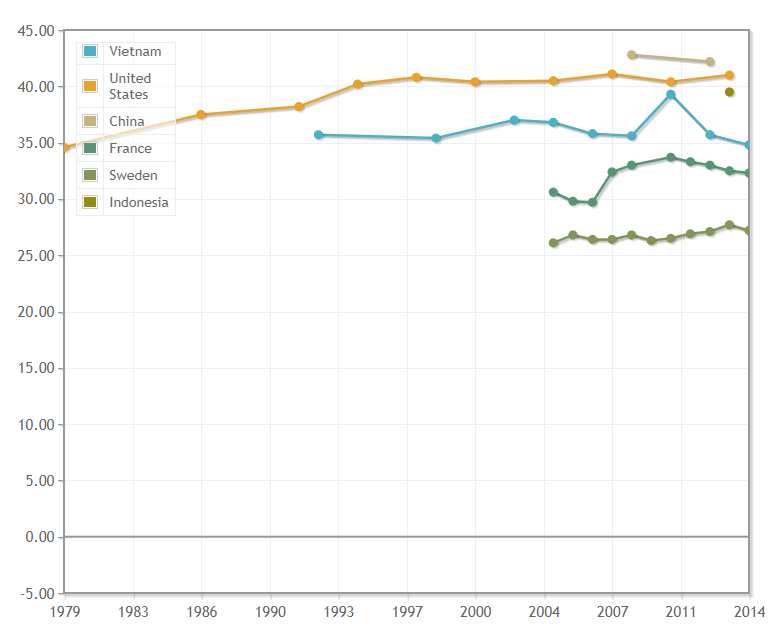
It is important to note that this problem exists world-wide, and Vietnam isn’t the worst offender by any stretch of the imagination. The GINI index is a statistical tool created to evaluate the distribution of wealth for any given country. As the reader can observe in the image below, when placed into a comparison chart with several developed nations, Vietnam actually did fairly well. France and Sweden have lower scores (about 33 and 27 respectively), but Vietnam’s score (35) was lower than both the U.S (41) and China (43). Additionally, Vietnam’s score beat out Indonesia, another frequently travelled Southeast Asian Nation. https://www.indexmundi.com/facts/vietnam/indicator/SI.POV.GINI
Vietnam has a relatively small wealth gap compared to nations like China; from 1993-2012 the average income of the lowest earning 40% grew 9% annually. This does not mean that inequality does not exist, however. There is still much disparity between the poor and the super-rich. This issue is especially prominent for minority groups, such as the Cham or the Khmer. Children of minority groups and poor families do not have access to the opportunities that rich children do, and malnutrition rates among these children are double those of rich children. Only 13% of Hmong and Dao children finish high school. Inequality also exists beyond the realm of ethnicity. https://www.worldbank.org/en/news/feature/2014/07/08/inequality-in-vietnam-a-special-focus-of-the-taking-stock-report-july-2014
In Vietnam, Women suffer from inequality in much the same way that they have historically been confronted with in the U.S, but to a greater extent than what we see in this present day. Females form much of the working poor class and are more vulnerable to unemployment. http://www.ilo.org/hanoi/Areasofwork/equality-and-discrimination/lang–en/index.htm
When they do manage to find employment, women earn less income than men. Although this information difficult to track due to a lack of statistical data, a few studies have indicated that the wage gap in Vietnam is a growing problem. According to a 2012 survey by the Vietnam General Confederation of Labour (VGCL), women, on average, earn about 70-80% of what men do, and this figure is only increasing. From 2012-13, the gap increased by 2%. http://www.ilo.org/hanoi/Informationresources/Publicinformation/Pressreleases/WCMS_206104/lang–en/index.htm
Women also suffer poor working conditions. Many are forced to take positions unpaid family workers and other “invisible” lines of work, such as homeworkers, street vendors, and entertainment positions. This is mainly due to the gender-based discrimination that runs rampant throughout the country. Gender bias has caused socio-economic institutions to work against women, making it very difficult to move upward through the economic scale. They have less access to resources, education, and job opportunities than their male counterparts. http://www.ilo.org/hanoi/Areasofwork/equality-and-discrimination/lang–en/index.htm
All in all, Vietnam struggles with the same issues as the rest of the world: racism, sexism, and socioeconomic institutions designed to keep those in power on the seat of authority. Unfortunately, that is just the world we live in. Progress is still being made, however, and Vietnam has many promising aspects. It may be some time before equity truly reigns, but all we can do until then is work towards a better tomorrow.
Works Cited
Britannica, The Editors of Encyclopaedia. “Khmer.” Encyclopædia Britannica, Encyclopædia Britannica, Inc., http://www.britannica.com/topic/Khmer.
Britannica, The Editors of Encyclopaedia. “Muong.” Encyclopædia Britannica, Encyclopædia Britannica, Inc., http://www.britannica.com/topic/Muong-people.
“Despite High Labour Force Participation Rate for Women, Gender Pay Gap on the Rise.” Despite High Labour Force Participation Rate for Women, Gender Pay Gap on the Rise, 7 Mar. 2013, http://www.ilo.org/hanoi/Informationresources/Publicinformation/Pressreleases/WCMS_206104/lang–en/index.htm.
“Equality and Discrimination in Viet Nam (ILO in Viet Nam).” Equality and Discrimination in Viet Nam (ILO in Viet Nam), http://www.ilo.org/hanoi/Areasofwork/equality-and-discrimination/lang–en/index.htm.
“Equality and Discrimination in Viet Nam (ILO in Viet Nam).” Equality and Discrimination in Viet Nam (ILO in Viet Nam), http://www.ilo.org/hanoi/Areasofwork/equality-and-discrimination/lang–en/index.htm.
“Inequality in Vietnam: A Special Focus of the Taking Stock Report July 2014 – Key Findings.” World Bank, http://www.worldbank.org/en/news/feature/2014/07/08/inequality-in-vietnam-a-special-focus-of-the-taking-stock-report-july-2014.
Nag, Oishimaya Sen. “Languages Spoken In Vietnam.” WorldAtlas, 8 Nov. 2016, http://www.worldatlas.com/articles/languages-spoken-in-vietnam.html.
“Out of Sight.” The Economist, The Economist Newspaper, 4 Apr. 2015, http://www.economist.com/asia/2015/04/04/out-of-sight.
“Vietnam – GINI Index (World Bank Estimate).” Vietnam – GINI Index (World Bank Estimate), http://www.indexmundi.com/facts/vietnam/indicator/SI.POV.GINI.
 Globalization: Asia