As a country with about 16 million people, Cambodia has one official language: Khmer. Khmer is spoken by about 90 percent of the population and has the longest alphabet in the world. Dialects have been formed due to geographical proximity. French, Mandarin, and English are also seen in Cambodia. French is mainly spoken by the older demographic, and English is spoken by the younger demographic. Minority languages include Cham, Vietnamese, and Tumpoon.
In 2010, UNESCO warned Cambodia that 19 ethnic languages faced extinction due to the increased use of Khmer and few people learning the ethnic language. In an attempt to save these languages, Care International has introduced bilingual school instruction for Cambodian communities. Children attending school learn in both the ethnic community language and in Khmer, the official language. However, language experts estimated that if Cambodia’s economic situation does not improve, then the indigenous languages will be lost.
Nationalism is identifying with your country and excluding culture from countries. A superiority complex is often associated with nationality. Nationalism is an ideology Cambodia is very familiar with. Khmer ethno-nationalism was a main contributing factor to the Cambodian genocide that took place from 1975-1979. Khmer extremists sought to eliminate the ethnic minorities from Cambodian society, and by doing so, killed about a quarter of the population.
Fareed Zakaria details his fears about the rise of nationalism in The Post-American World. Nationalism rises as economic fortunes rise. Nations are now realizing their potential to be players on the world stage. As prominence rises, confidence in decision-making and assertiveness will grow. Therefore, nation-states are less willing to come together to solve problems. In addition, global organizations are becoming outdated. For example, the UN Security Council’s permanent members shows the antique system of major world powers. The permanent members, listed in Manfred B. Steger’s Globalization: A Very Short Introduction, are China, Russian Federation, France, United States, and the United Kingdom.
At the time of the genocide, inequality in Cambodia was at its highest. However, economically, Cambodia has fully recovered and improved.
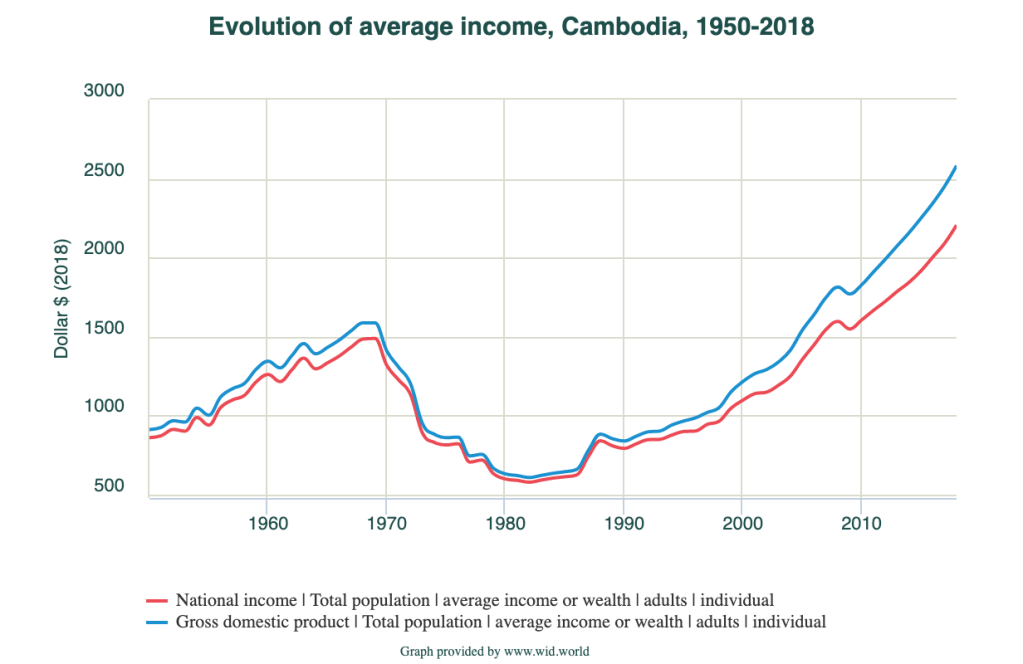
There is increased access to education and healthcare. Overall, equality has improved in Cambodia, but there is more work to be done. Gender inequality is high, and some regions do not have access to healthcare. To address gender inequality and increased health, Cambodia has encouraged mothers to breastfeed. The Gini Coefficient measures income inequality where a coefficient of zero means perfect income equality. Cambodia has a coefficient of 37.9 which is better than 77 other countries in the world. To address income inequality, Cambodia has been fighting for a higher minimum wage. The Human Development Indicator (HDI) is a measure of average achievement in key dimensions of human development. Cambodia has an index of 0.582 compared to the global average of 0.728, and Cambodia’s index has had an upward trend over the past 20 years.
 Globalization: Asia